The shape of the NHL has changed quite drastically over the last 100 years. When the league first started in 1917 forward passing was not allowed, the top players played almost sixty minutes a game, and goalies were not allowed to drop to the ice to save a puck. Even more: goalies served their own penalties, forcing their team to defend an empty net!(1)
With these changes to the game there has also been changes to the players, with some characteristics changing drastically, and some remaining surprisingly steady. In this post I'm going to conduct a deep dive into player demographic data for every single NHL roster from the 1917-1918 season to the 2024-2025 season.
We'll look at the trends in nationality, age, height, and weight across a comprehensive dataset of every single NHL player on every single NHL roster since 1917. That is, 8,595 unique players rostered 55,567 times total across 107 season rosters.
Nationality: From pure Canada to North American Mix
It makes sense that Canada once dominated the player base of the NHL. After all, the NHL sprung into existence in 1917 after the dissolution of the "National Hockey Association of Canada" (NHA) which was centered entirely in Ontario and Quebec.(2) As the NHA became the NHL, all five original teams were based in Ontario and Quebec. It was only in the 1920s to 1940s that the league expanded into the United States, forming what are now known as the "Original Six:" The Boston Bruins, Chicago Blackhawks, Detroit Red Wings, Montreal Canadiens, New York Rangers, and Toronto Maple Leafs.
As you can see below, Canada once dominated the composition of the NHL with, at some points, over 95% of players being Canadian. Now, there is an almost even split with 40% of the NHL being Canadian and 31% being American. One plausible explanation is simply a decline in Canadian youth hockey infrastructure, coupled with an increase in American youth hockey infrastructure. While it is not huge, Under-18 participation in hockey in Canada has declined 17% from 2009 to 2023, while in the US it has risen 14%.(3) This data of course does not go all the way back to the 1970s, where the decline in Canadian domination began.
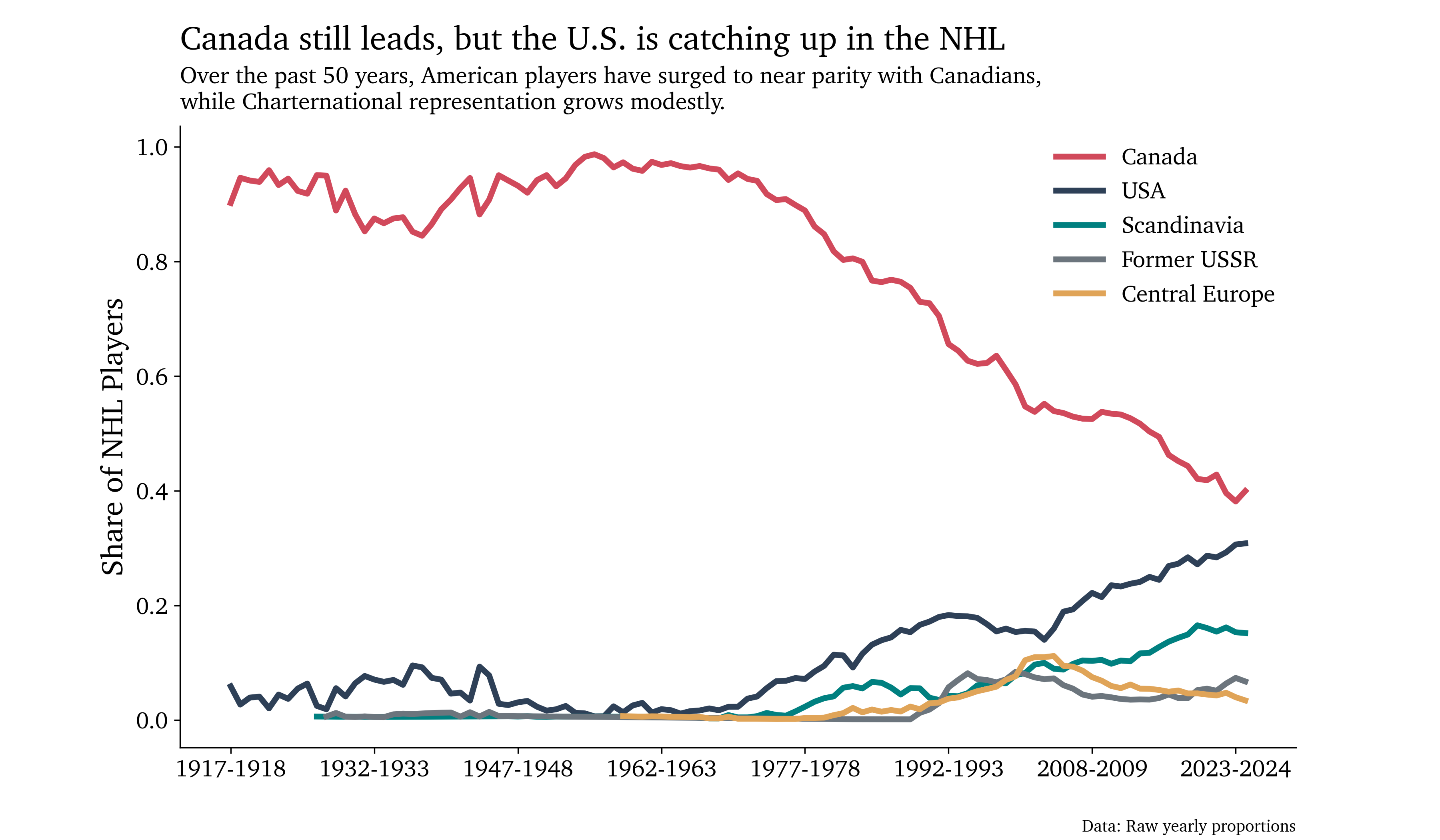
The 1970s, though, is when the NHL experienced its largest expansion, going from 12 teams (2 Canadian, 10 American) in the 1969-1970 season to 21 teams (6 Canadian, 15 American) in the 1979-1980 season with the addition of 4 Canadian teams and 5 American. This steady increase in American teams is one very likely explanation for this mix-shift in nationality. The league went from 100% Canadian teams in 1917 to 22% in 2024. The NHL has just continually expanded without really adding Canadian franchises.
I would also be remiss if I didn't touch on the more international expansion. The numbers are relatively low for non-North American countries, but still notable with 25% of the league coming from Scandinavia, the Former USSR, and Central Europe more broadly.
Age: Fluctuations Tied to the Structure of the League
Since 1917, age has followed a relatively flat, but somewhat interesting trend. Truthfully, there seem to be a number of interesting things depending on the time frame you look at.
First, there seems to be a sort of odd sinusoidal trend where, regardless of position, players hovered around 28 years old in 1917, got progressively younger until about 1950, got older until the mid 1960s, got younger again until the late 1980s, and then finally have gotten older again and now sort of plateaued. It's worth noting that these changes aren't seismic, really ranging only from about 24 to 28 years of age.
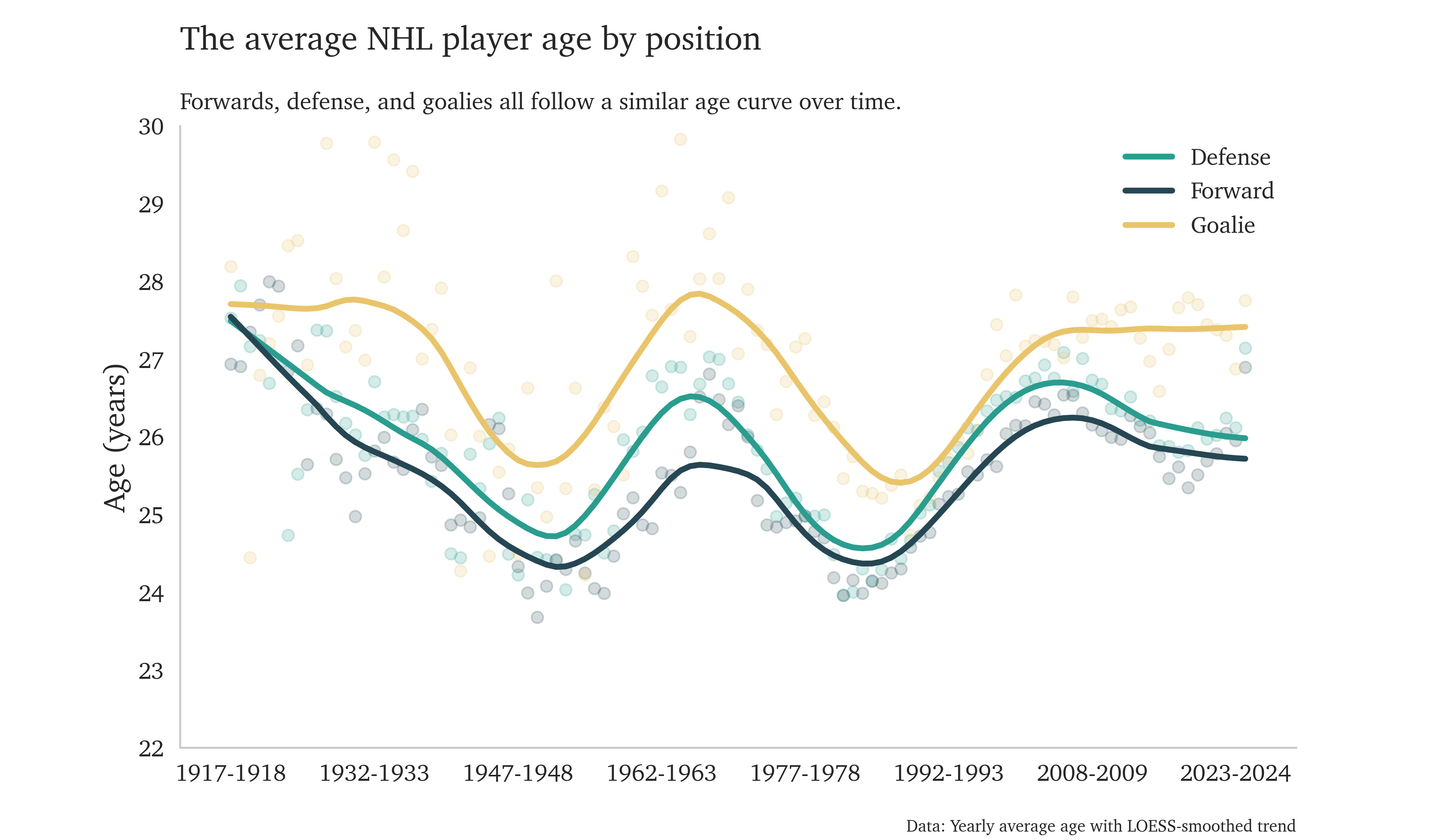
I think one possible reason for this cycle is simply how the league expanded and changed over the years. The general trend seems to be "expansion = age decline." Interestingly, the shifts in trend seem to track quite closely with the "eras" of the league.(4) Up until 1942, in the early era, the league fluctuated growing from four to ten teams, then back down to seven. In this era, the size of the league fluctuated but overall grew from 45 players in the 1917-1918 season to 160 players in the 1941-1942 season; again, more players, lower age.
Following this, 1942 to 1967 the team stayed at 6 teams, the "original six" era. As you can see, in this era the league slowly aged. No expansion, no injection of new players, less roster turnover. The league simply aged in place. Then, from 1967 to 1991 the NHL experienced its largest expansion era, growing 250% from 6 to 21 teams. In this era, the league again got younger and younger. From 1991 to 2017 the league again expanded, but only 30%. Less need for new young players, more static rosters, the league ages again. Finally, from 2017 until now the league has only added one team, and age has stagnated.
One other interesting recent trend is that goalies have remained static around 28 years old while forwards and defencemen have declined from 28 to about 26 years old. I suspect this modern-era age change simply reflects the speed and demands of modern athletics. Goalies can afford to be a hair older, while skaters must deal with the increasing demands of the sport and cannot afford to be older. This is a trend we have seen in numerous sports. Cycling grand tour winners used to be mature in their career, around 27-28 years old and are now falling more in their mid to early 20s. Athletes are starting earlier, developing faster, winning sooner, and then retiring around previous peak ages.
Height: A Steady Increase and Biological Stagnation
There are again some interesting trends when it comes to how height has changed over the years. By and large, players have gotten taller, which is not entirely surprising. The average height of a Canadian man in 1920 was ~171cm. By 2014, this had grown to be ~178cm. This raw 7cm, or 4%, increase roughly tracks the NHL change of 176 to 187cm, a 6% increase, over the same time period.
So it's not really that the league is getting taller, it's simply most likely that people were getting taller over the same time period, and the NHL kept up, maybe outpacing the general population slightly. Naturally, the athletes are a bit taller than the general population overall.
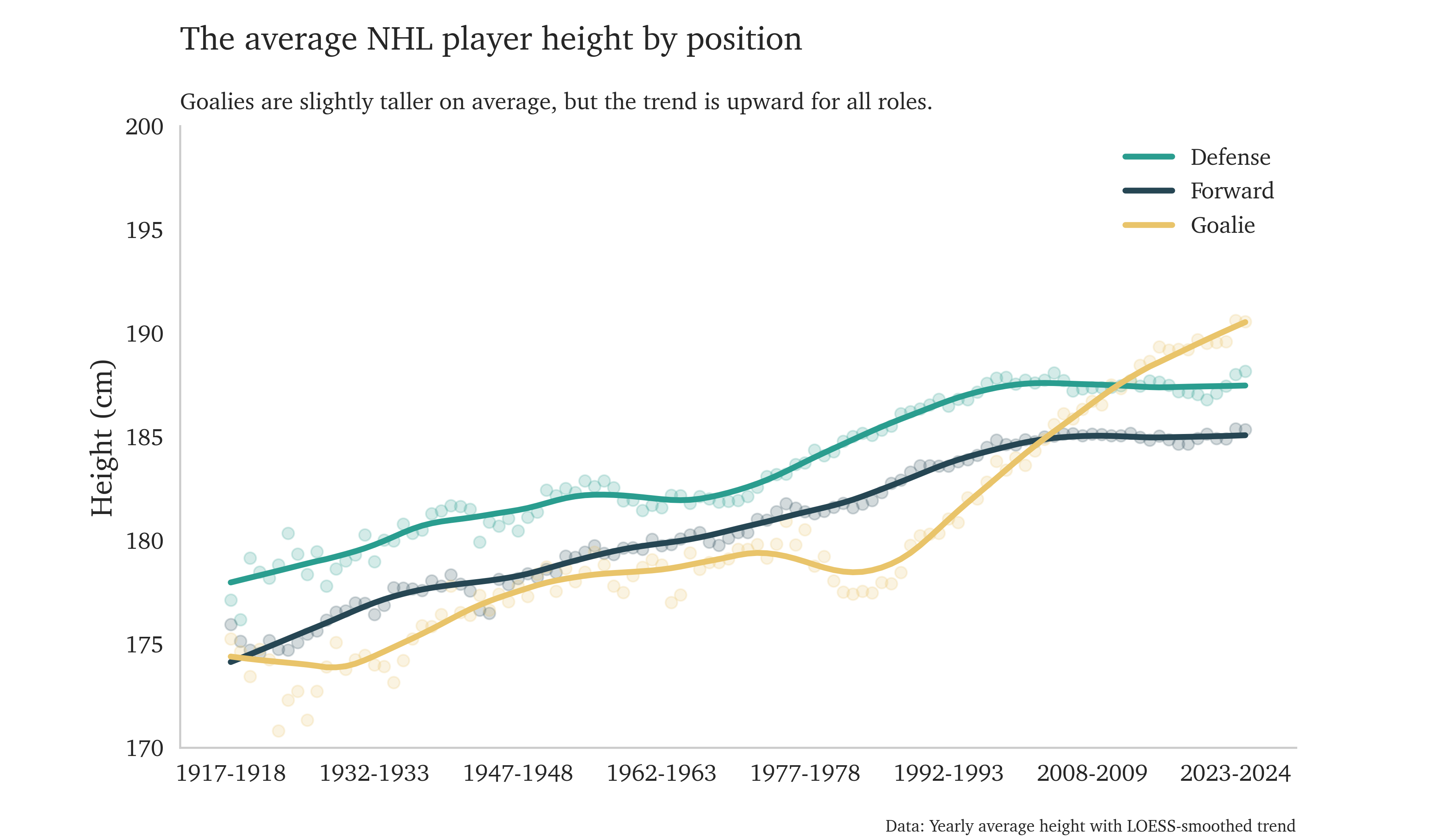
I think what is most interesting here, though, is the change in positional heights. For almost the entire history of the NHL, goalies were the smallest position by height (and weight, but more on that below). However, come the late 1980s and early 1990s this began to shift and goalies saw a dramatic rise in their overall height, eventually becoming the tallest players around 2010.
While there are many plausible reasons for this, one that I think rises to the top is implementation of helmets for goalies with the the shift towards the butterfly, or "profly" style popularized in the mid 1980s by Patrick Roy.(5) Goalies were first required to wear masks in 1979-1980, followed quickly by some equipment changes that made it feasible for a goalie to drop to his knees (masks and more heavily armored chest and arm pads).
Now, instead of relying on their gloves, with an unprotected face, goalies could drop to their knees and use their whole body to stop the puck. As Patrick Roy came along in the mid 1980s and popularized the style, it was now the reality that a goalie could be both large AND agile AND use their whole body. Thus, it was much more effective now to be a large goalie, possibly kicking off the slow and steady height trend we see now.
Weight: Slow and Steady Rise to an Eventual Decline
There are a few interesting trends with the average weight of NHL players. Overall, there has been a steady increase from ~175lbs average to a peak of near 205lbs, with now a drop to slightly below 200lbs average. This trend mirrors the height changes, at least until weight begins to decline: as players get taller, they get heavier.
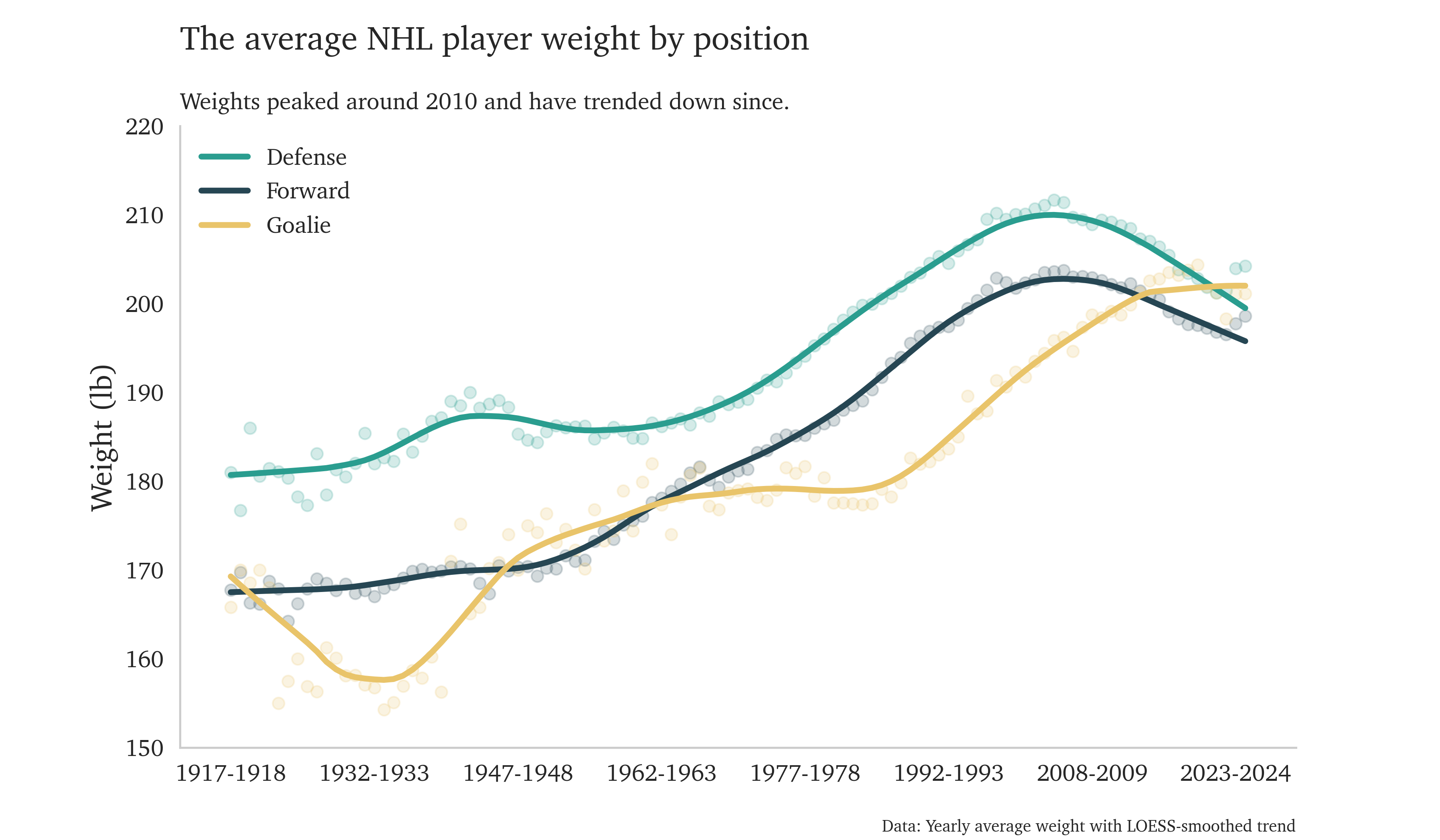
But, similar to the changes in goalie height, there may have been a shift in the last 15 to 20 years that allows players to be more effective while being lighter. There are a number of possible shifts that all seem plausible. One big change is likely that development and nutrition have changed. Players are starting younger, training more effectively, eating better. As a result, the league is getting faster and faster.(6)
Young guys are coming in faster, older guys have to shed some kilos to match the speed and pace, and the league shrinks. There has also been some suggestion, like in other areas of the player demographics, that a shifting of the rules of the game have had an effect.(7)
Specifically, there was a large swath of rule changes in the 2005-2006 season, right at the peak of the NHL's size, that were designed to encourage faster, more aggressive offensive play.(8) For example, the league eliminated the two-line pass rule making it such that players could pass from their defensive zone across the red line, allowing for longer stretch passes, quick transitions, and breakaways. Additionally, the league reinstated the "tag-up" rule for offsides, allowing an offensive player to simply pop one skate out of the zone and re-enter. This, as opposed to having to fully exit the zone, come to a stop, and re-enter, allows the game to maintain a faster and more aggressive pace.
Conclusion and New Questions
Over the last hundred-odd years, the league has become more globalized, gotten taller, gotten lighter, and fluctuated in age. There are a number of plausible reasons for each of these shifts, ranging from just general population changes, to advancements in nutrition and training, to simple NHL rule changes that reward different styles of play.
I think this simple analysis of historical trends opens up a lot of interesting analytic windows. Here, I have simply chronicled these changes in a way that many have before. Moving forward, I think it would be important to understand the effects of these demographics. The NHL changed the rules to reward faster more aggressive play; do lighter, younger teams fare better? Goalie pads and playstyles have changed; do heavier, taller goalies actually perform better? I noted that demographic shifts happen to coincide with league expansions; do rosters actually turnover more (i.e., more retiring players, more new incoming players) in eras of expansion?
There are a ton of open questions that I will continue to explore in these deep dives.